A delivery challan and packing slip travel with your goods; the tax invoice attaches the value and the tax. They are two different jobs, so Fast Billing keeps them as two clean documents — challan and packing slip out with the shipment, e-way-bill data ready, and the invoice raised later against that dispatch. Cloud or on-premise, for Indian SMEs and businesses worldwide.
The challan and packing slip get the material out of the door and onto the vehicle; the tax invoice is a separate, financial document raised against that dispatch. New to the category? Start with what is GST billing software.
When a shipment leaves, something has to go with it. The delivery challan is that document — it accompanies the goods in transit and moves them out of your store — and the packing slip lists what is physically in each carton, so the driver, the customer and the goods all agree. Neither is a bill: they carry quantity and description, not a demand for payment. That keeps your dispatch paperwork clean and your customer's goods-inward check simple.
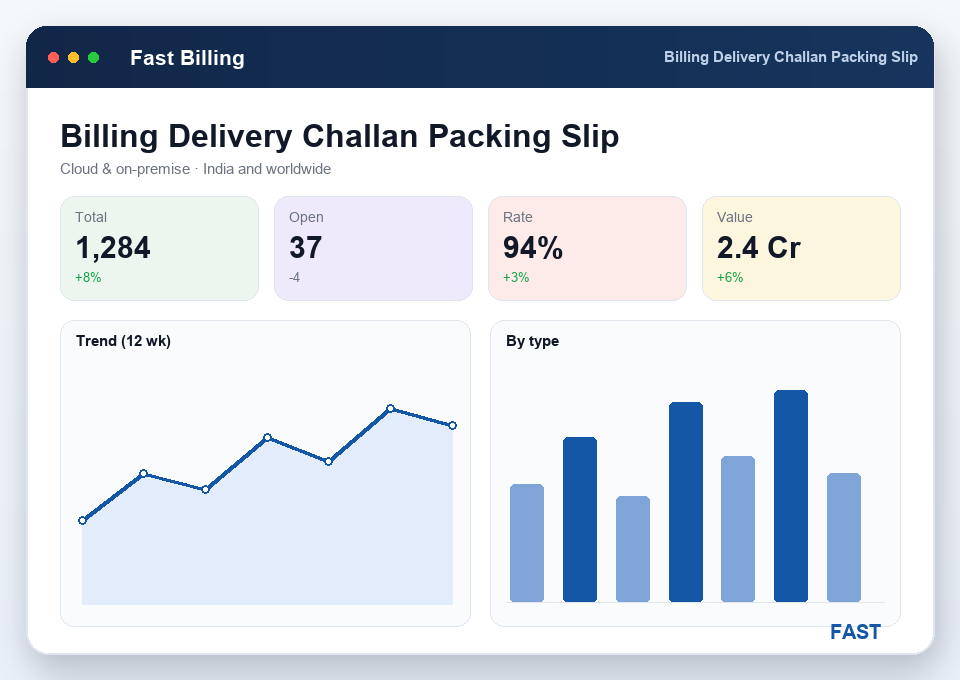
A challan transfer is a goods-movement document: it records material going out on a challan — to a customer, or between your own locations — and captures where the goods now are. It is a movement, not a bill. And because the move is recorded, it becomes the reference the tax invoice is later raised against, so the physical dispatch and the billing document stay tied together without anyone re-typing the lines.
An e-way bill needs party, ship-to, item lines, quantity, value and HSN — and those live on the dispatch already. So instead of re-keying the shipment into an e-way-bill form and then again into the invoice, the challan supplies the data once, and the e-way bill and the tax invoice are both built from the same movement. Goods, e-way bill, paperwork and vehicle all describe one shipment, so a roadside check finds everything consistent.
This is the heart of it: the challan is a stock event and the invoice is a financial event. The goods physically leave the building at the dispatch step; the tax invoice, raised later, attaches value and GST to that already-dispatched material — it does not move stock again. That clean split is what lets billing run independently of the warehouse, and a double-bill guard tracks how much of each dispatched quantity has been invoiced, so a shipped lot can never be billed twice.
The document that accompanies goods in transit and moves them out of the store — quantity and description, no tax amount.
Lists what is physically in each carton so the goods, the paperwork and the customer's inward check all agree.
A goods-movement document that records material leaving on a challan and becomes the reference the invoice is raised against.
Party, ship-to, quantity, value and HSN come off the dispatch, so the e-way bill and invoice are built from one movement.
The tax invoice is raised against the challan/dispatch — financial-only, so billing never touches stock a second time.
See what has left on challans, what has been invoiced and what is still pending to bill — the two documents reconciled.
Treating the challan and the invoice as one document is how dispatches get billed twice and e-way bills disagree with the invoice. Here is what keeping them distinct changes. See the format in our GST invoice format guide.
They are two deliberately distinct documents. The delivery challan (and packing slip) accompanies the goods in transit and moves them out of the store; the tax invoice attaches commercial and tax value and bills the customer. The challan moves goods, the invoice bills them. Fast Billing keeps them separate on purpose, and the tax invoice is later raised against the dispatch the challan represents.
Yes. The dispatch details on the challan — party, ship-to, item lines, quantity, value and HSN — supply the data an e-way bill needs, so the e-way bill and later the tax invoice are built from the same movement rather than being re-keyed. The packing slip lists what is physically in each carton so the goods, the paperwork and the vehicle all agree.
A challan transfer is a goods-movement document that records material moving out on a challan — for example a stock transfer between locations or goods sent on a delivery challan. It is a movement, not a bill: it changes where the goods are, and it becomes the reference the tax invoice is later raised against.
Because invoicing is a financial event, not a stock event. The goods physically leave the building at the dispatch/challan step; the invoice simply attaches value and GST to that already-dispatched material. That clean split is what lets billing run independently of the warehouse — and a double-bill guard tracks how much of each dispatched quantity has been billed so it can never be invoiced twice. If a whole invoice must be voided, cancel it through credit & debit notes to release the dispatch.
Yes. Goods can leave on a delivery challan and the tax invoice can be raised against that dispatch afterwards — billing only what actually left. Because the invoice references the dispatch, you always know what has been dispatched, what has been billed, and what is still pending to invoice.
Live demo of the challan, packing slip and against-dispatch invoice on your own shipments. No generic slideshow.